
When Care Isn’t Enough: Scaling Emergency Aid During the COVID-19 Pandemic (2021)
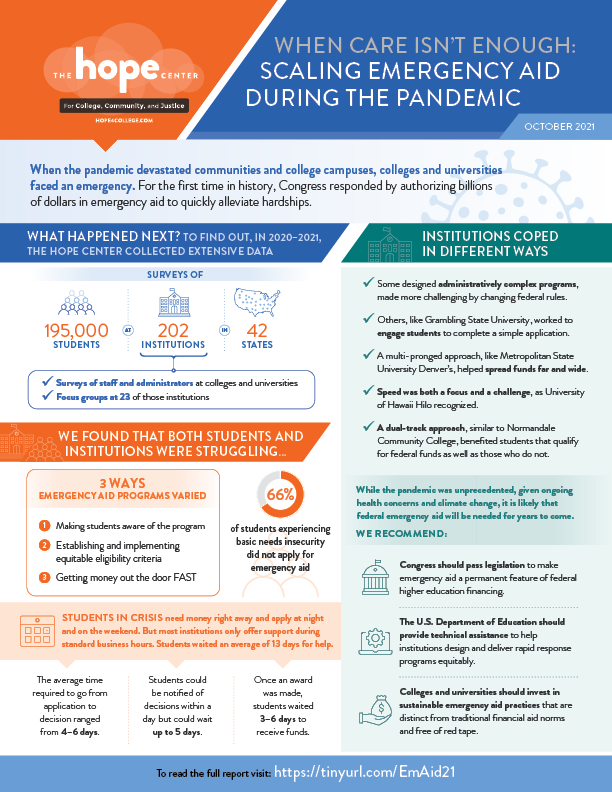
When the pandemic devastated communities and college campuses, colleges and universities faced an emergency. For the first time in history, Congress responded by authorizing billions of dollars in emergency aid to quickly alleviate hardships.

This report shows how colleges and universities met the challenge of emergency aid during the pandemic, drawing on a year of surveys and focus groups, fielded and conducted by The Hope Center and DVP-Praxis, that reflect the views of institutional leaders and students from coast to coast. The results offer valuable insights that should shape the future of emergency aid and student support. While the onset of the pandemic was unprecedented, its ongoing health concerns and the looming consequences of climate change ensure that knowing how to deliver emergency aid at scale will be essential to the well-being of future students. With these lessons in mind, we can all be better prepared and ready to respond.
The Real Price of College: Estimating and Supporting Students’ Financial Needs (2021)

For decades, complicated financial aid formulas and variable sticker prices have made it difficult for students to understand the real price of college. For colleges, understanding students’ financial need is also challenging; current financial aid formulas cause many students’ actual need to be understated.
This report examines what happens when:
financial aid leaders and staff better understand students’ financial need, as operationalized by negative EFC; and
students better understand college costs and how to advocate for more financial support.
Using data gathered at Temple University and six colleges and universities in Texas, we explore how more nuanced information about college costs and financial need can change beliefs and behavior among financial aid staff, leaders, and students.

Experimental Evidence on the Impacts of Need-Based Financial Aid: Longitudinal Assessment of the Wisconsin Scholars Grant (2020)

We conduct the first long-term experimental evaluation of a need-based financial aid program, the privately funded Wisconsin Scholars Grant. Over multiple cohorts, the program failed to increase degree completion and graduate school enrollment up to 10 years after matriculation. The program did reduce time-to-degree for some students and modestly increased the number of STEM degrees earned. The lack of robust effects raises important questions about the conditions necessary for financial aid to benefit students.